The Definitive Guide to Investing in Gold ETFs within a Roth IRA
The Definitive Guide to Investing in Gold ETFs within a Roth IRA

\n\n## Gold ETFs in Roth IRAs: A Macro Realist’s Guide
Gold Exchange Traded Funds (ETFs) offer investors a route to gain exposure to gold prices without directly purchasing physical bullion. For those seeking long-term, tax-advantaged savings, incorporating gold ETFs into a Roth IRA can be a strategic move. This section provides a detailed overview of gold ETFs, their mechanics, and how they function within a Roth IRA framework.
Understanding Gold ETFs

A gold ETF is an investment fund that typically holds physical gold bullion or invests in gold futures contracts. The ETF’s price aims to mirror the spot price of gold, less the fund’s operating expenses. These ETFs trade on stock exchanges like individual stocks, offering liquidity and ease of access.
Types of Gold ETFs:
-
Physically Backed Gold ETFs: These ETFs hold physical gold bullion in vaults, with each share representing a fraction of an ounce of gold. Examples include the SPDR Gold Trust (GLD). GLD, one of the largest gold ETFs, held approximately 824.63 tonnes of gold as of October 2024. The fund’s objective is to reflect the performance of the price of gold bullion, less the Trust’s expenses.
-
Gold Futures ETFs: These ETFs invest in gold futures contracts, which are agreements to buy or sell gold at a predetermined price and date. These ETFs may use leverage to amplify returns, but this also increases risk. An example is the ProShares Ultra Gold (UGL), which seeks daily investment results, before fees and expenses, that correspond to two times (2x) the daily performance of the Bloomberg Gold Subindex. Investing in futures requires careful management due to contract expirations and potential roll-over costs.
-
Gold Mining ETFs: These ETFs invest in companies involved in gold mining and production. While correlated to gold prices, their performance is also influenced by factors specific to the mining industry, such as operational costs, geopolitical risks, and management decisions. The VanEck Gold Miners ETF (GDX) is a prominent example, with net assets of approximately $11.97 billion as of October 2024.
Gold ETFs vs. Physical Gold: A Comparative Perspective
While physical gold provides direct ownership and eliminates counterparty risk, ETFs offer convenience and lower storage costs. However, ETFs incur management fees, and physically backed ETFs are still subject to the custodian’s solvency. As a store of value lacking counterparty risk, physical gold has historically served as protection against currency devaluation. For example, since 2000, the U.S. dollar has lost approximately 40% of its purchasing power.
The Role of a Roth IRA
A Roth IRA is a retirement account that offers tax-advantaged growth. Contributions are made with after-tax dollars, but qualified withdrawals in retirement are tax-free. This can be particularly beneficial for assets expected to appreciate significantly over time, such as gold.
Key Features of a Roth IRA:
- Tax-Free Growth: Investment gains within the Roth IRA grow tax-free.
- Tax-Free Withdrawals: Qualified withdrawals in retirement are tax-free.
- Contribution Limits: For 2024, the contribution limit for Roth IRAs is $7,000, with an additional $1,000 catch-up contribution allowed for those age 50 and over.
- Income Restrictions: High-income earners may be limited or unable to contribute to a Roth IRA directly.
Investing in Gold ETFs within a Roth IRA
Incorporating gold ETFs into a Roth IRA requires opening a Roth IRA account with a brokerage firm that allows trading in ETFs. Once the account is open, funds can be transferred or contributed, and the gold ETF can be purchased like any other stock or ETF.
Steps to Include Gold ETFs in a Roth IRA:
- Open a Roth IRA: Choose a brokerage that offers Roth IRA accounts and access to a wide range of ETFs.
- Fund the Account: Contribute up to the annual limit, keeping in mind any income restrictions.
- Research Gold ETFs: Evaluate different gold ETFs based on their structure (physical vs. futures), expense ratios, and trading volume.
- Place the Trade: Purchase the desired gold ETF through the brokerage’s trading platform.
- Rebalance Periodically: Review your portfolio regularly and rebalance to maintain your desired asset allocation.
Considerations and Caveats

- Expense Ratios: Gold ETFs charge expense ratios, which can erode returns over time. For example, the SPDR Gold Trust (GLD) has an expense ratio of 0.40%. Investors should compare expense ratios across different ETFs.
- Tracking Error: Gold ETFs may not perfectly track the spot price of gold due to factors such as storage costs, transaction fees, and futures contract roll costs.
- Counterparty Risk: While physically backed gold ETFs hold physical gold, they are still subject to the custodian’s solvency and security.
- Volatility: Gold prices can be volatile, and gold ETFs are subject to market fluctuations.
Strategic Asset Allocation

The percentage of a portfolio allocated to gold ETFs should align with an investor’s risk tolerance, investment goals, and time horizon. As a portfolio diversifier, gold can offer a hedge against inflation and currency devaluation. However, it does not generate income like stocks or bonds, so its role is primarily capital preservation.
Historical Context:
During periods of monetary expansion, gold has historically maintained its purchasing power. For instance, in the 1970s, as the U.S. dollar weakened, gold prices surged from $35 per ounce in 1970 to over $600 per ounce by 1980.
Tax Implications within a Roth IRA

One of the primary advantages of holding gold ETFs within a Roth IRA is the tax-free nature of qualified withdrawals. Any gains realized from the sale of gold ETFs within the Roth IRA are not subject to capital gains taxes, providing a significant benefit over taxable accounts. This is especially advantageous given the potential for long-term appreciation in precious metals.
By understanding the mechanics of gold ETFs and the benefits of a Roth IRA, investors can make informed decisions about incorporating gold into their long-term retirement savings strategy. \n\n\n### Why Invest in Gold ETFs within a Roth IRA?
Investing in gold Exchange Traded Funds (ETFs) within a Roth IRA offers a strategic approach to capital preservation and long-term growth. The core rationale rests on diversification, inflation hedging, and the potential for value appreciation, all within a tax-advantaged framework.
Diversification Benefits

Modern portfolios often suffer from excessive correlation. Gold, historically, has exhibited a low to negative correlation with traditional asset classes like stocks and bonds. This inverse relationship can be particularly valuable during periods of market turbulence. For example, during the 2008 financial crisis, while the S\&P 500 plummeted, gold prices saw a substantial increase, demonstrating its potential as a safe haven asset [Source: Bloomberg].
Diversification is not about maximizing returns in a single asset class, but rather optimizing risk-adjusted returns across the entire portfolio. By allocating a portion of a Roth IRA to gold ETFs, investors can mitigate the impact of market volatility and improve overall portfolio stability. A study by the World Gold Council found that a portfolio allocation of 2-10% to gold can enhance risk-adjusted returns over the long term.
Inflation Hedge
Inflation erodes the purchasing power of fiat currencies. Central banks’ expansionary monetary policies often exacerbate this effect. Gold, conversely, has historically served as a reliable store of value during inflationary periods. Unlike fiat currencies, gold’s supply is limited, making it less susceptible to devaluation.
The CPI in the US has risen 3.3% year-on-year, signaling an ongoing erosion of purchasing power. Gold can act as a hedge against this erosion. During the inflationary period of the 1970s, for instance, gold prices increased significantly, outpacing inflation and preserving wealth. While past performance is not indicative of future results, gold’s historical track record as an inflation hedge remains compelling. Since 2000, gold has appreciated by approximately 500%, outperforming many traditional inflation hedges.
Long-Term Value Potential

Gold’s value is derived from its scarcity, its use in jewelry and industrial applications, and its historical role as a monetary asset. Central banks globally hold substantial gold reserves, underscoring its continued importance in the international monetary system. As of 2024, central banks hold approximately 20% of the world’s above-ground gold.
Furthermore, increasing demand from emerging markets, particularly China and India, supports gold’s long-term value potential. These nations have a strong cultural affinity for gold, and their growing middle classes are driving demand for both investment and consumption purposes. The shift towards de-dollarization among certain nations could further bolster gold’s appeal as a reserve asset, potentially driving prices higher.
Tax Advantages of a Roth IRA

The Roth IRA offers significant tax advantages, particularly for long-term investors. Contributions are made with after-tax dollars, but earnings and withdrawals are tax-free in retirement. This tax-free growth can substantially enhance the returns on gold ETF investments over time.
Compounding tax-free within a Roth IRA allows investors to accumulate wealth more efficiently. For example, if a gold ETF appreciates by an average of 7% per year over a 20-year period, the tax-free gains within a Roth IRA would be significantly higher compared to a taxable account. This advantage is especially beneficial for an asset like gold, which may experience significant price appreciation over the long term.
Strategic Considerations

When investing in gold ETFs within a Roth IRA, it’s important to consider several strategic factors:
- Allocation Size: Determine an appropriate allocation size based on your risk tolerance, investment horizon, and overall portfolio composition. As noted previously, a [2-10%] (https://www.gold.org/goldhub/how-to-invest-in-gold/gold-as-a-strategic-asset) allocation is often cited as a reasonable starting point.
- ETF Selection: Choose a gold ETF with a low expense ratio and high liquidity. Expense ratios can erode returns over time, so it’s important to select a cost-effective option.
- Rebalancing: Periodically rebalance your portfolio to maintain your desired asset allocation. This involves selling some gold ETFs if their value has increased significantly and reallocating the proceeds to other asset classes.
- Long-Term Perspective: Gold is generally considered a long-term investment. Avoid making short-term trading decisions based on market fluctuations. Focus on the long-term fundamentals driving gold’s value.
Counterarguments and Risks
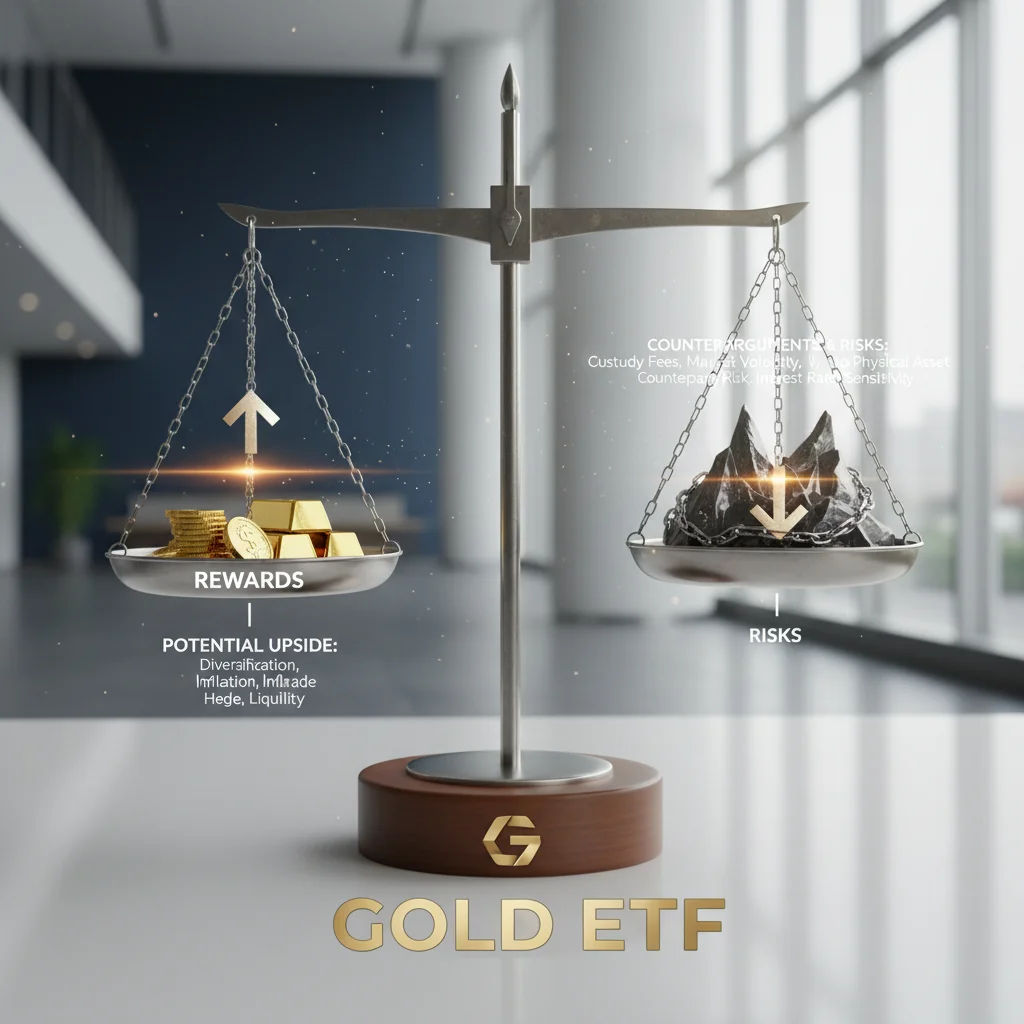
While gold offers several potential benefits, it’s important to acknowledge the counterarguments and risks associated with investing in gold ETFs:
- Lack of Yield: Gold does not generate income like stocks or bonds. Its returns are solely dependent on price appreciation.
- Volatility: Gold prices can be volatile in the short term. Market sentiment, geopolitical events, and macroeconomic factors can all influence gold prices.
- Opportunity Cost: Investing in gold means foregoing potential returns from other asset classes. It’s important to consider the opportunity cost when allocating capital to gold.
- Storage Costs (Indirect): While you aren’t directly storing physical gold, the ETF incurs storage and management costs, which are reflected in the expense ratio.
Concluding Thoughts

Investing in gold ETFs within a Roth IRA can be a prudent strategy for diversification, inflation hedging, and long-term capital preservation. The tax-free growth offered by a Roth IRA can amplify the returns on gold investments over time. However, it’s crucial to carefully consider your individual circumstances, risk tolerance, and investment objectives before making any investment decisions. A well-informed approach, combined with a long-term perspective, is essential for successfully incorporating gold ETFs into a Roth IRA. \n\n\n### How to Invest in Gold ETFs within a Roth IRA: A Step-by-Step Guide
Investing in gold ETFs within a Roth IRA can offer tax advantages and portfolio diversification. This section provides a detailed, step-by-step guide to navigate the process effectively.
1. Open a Roth IRA Account
The first step is to open a Roth IRA account with a brokerage firm. Popular choices include Fidelity, Vanguard, and Charles Schwab. When selecting a broker, consider factors such as:
- Fees: Look for low or no account maintenance fees. Many brokers have eliminated these fees to attract more customers.
- Investment Options: Ensure the broker offers a wide range of gold ETFs.
- Research Tools: Check for robust research tools and educational resources to help you make informed decisions.
- Minimum Investment: Some brokers may require a minimum initial investment, although many have eliminated this requirement as well.
The annual contribution limit for Roth IRAs is determined by the IRS. For 2024, the contribution limit is $7,000 for individuals under age 50. Individuals age 50 and over can contribute an additional $1,000 as a “catch-up” contribution, for a total of $8,000. Contributions to a Roth IRA may be tax deductible, depending on your income and filing status.
2. Fund Your Roth IRA
Once your Roth IRA account is open, you need to fund it. You can transfer funds from a bank account, another retirement account, or through a rollover from a traditional IRA or 401(k).
- Bank Transfer: The simplest method is to transfer funds electronically from your bank account to your Roth IRA.
- Rollover: If you have funds in a traditional IRA or 401(k), you can roll them over into a Roth IRA. Be aware that a rollover from a traditional IRA to a Roth IRA may trigger a tax liability in the year of the conversion. It is crucial to understand the tax implications before initiating a rollover.
Remember that contributions must be made in cash. You cannot contribute physical gold directly to a Roth IRA.
3. Research and Select a Gold ETF
Choosing the right gold ETF is crucial. Consider these factors:
- Expense Ratio: The expense ratio is the annual fee charged by the ETF to cover its operating expenses. Look for ETFs with low expense ratios to minimize costs. For example, the SPDR Gold Trust ETF (GLD) has an expense ratio of 0.40%.
- Liquidity: Liquidity refers to how easily you can buy and sell shares of the ETF. High trading volumes and tight bid-ask spreads indicate good liquidity. GLD, for instance, typically has high trading volumes, making it a liquid investment.
- Tracking Error: Tracking error measures how closely the ETF’s performance matches the price of gold. Lower tracking error indicates better performance alignment.
- Holdings: Understand what the ETF holds. Most gold ETFs hold physical gold bullion, but some may invest in gold mining stocks.
- Issuer Reputation: Choose ETFs from reputable issuers like BlackRock (iShares), State Street (SPDR), and VanEck.
Example Gold ETFs:
- SPDR Gold Trust (GLD): This is one of the largest and most liquid gold ETFs, holding physical gold bullion.
- iShares Gold Trust (IAU): IAU is another popular option with a slightly lower expense ratio than GLD.
- VanEck Gold Miners ETF (GDX): GDX invests in gold mining companies rather than physical gold. It can offer higher potential returns but also carries more risk due to its exposure to the equity market.
4. Place Your Trade
Once you have selected a gold ETF, you can place a trade through your brokerage account.
- Order Type: Choose between a market order and a limit order. A market order executes immediately at the current market price, while a limit order allows you to specify the price at which you are willing to buy or sell.
- Quantity: Determine how many shares you want to purchase based on your investment goals and risk tolerance.
- Review and Confirm: Before submitting your order, review all the details to ensure they are correct.
Example:
Let’s say you want to invest $1,000 in GLD, which is currently trading at $200 per share. You would place a market order to buy 5 shares of GLD.
5. Monitor and Rebalance Your Portfolio
After investing in a gold ETF, it’s essential to monitor its performance regularly and rebalance your portfolio as needed.
- Regular Reviews: Check your portfolio at least quarterly to assess the performance of your gold ETF and ensure it aligns with your investment objectives.
- Rebalancing: Rebalancing involves adjusting your asset allocation to maintain your desired risk profile. For example, if gold has significantly outperformed other assets in your portfolio, you may want to sell some of your gold holdings and reinvest in other asset classes to bring your portfolio back into balance.
- Stay Informed: Keep abreast of market news and economic trends that could impact the price of gold.
6. Understand the Tax Implications
Investing in a Roth IRA offers significant tax advantages.
- Tax-Free Growth: Investments within a Roth IRA grow tax-free.
- Tax-Free Withdrawals: Qualified withdrawals in retirement are tax-free. To qualify, you must be at least 59 1/2 years old and have held the Roth IRA for at least five years.
- Early Withdrawals: Contributions (but not earnings) can be withdrawn tax-free and penalty-free at any time. However, withdrawing earnings before age 59 1/2 may be subject to taxes and penalties.
7. Diversify Your Roth IRA
While gold can be a valuable addition to a Roth IRA, it’s important to diversify your portfolio across different asset classes.
- Stocks: Include a mix of domestic and international stocks to provide growth potential.
- Bonds: Add bonds to reduce risk and provide income.
- Real Estate: Consider including real estate through REITs (Real Estate Investment Trusts) for diversification.
A well-diversified portfolio can help you achieve your financial goals while managing risk effectively.
8. Consider Dollar-Cost Averaging
Dollar-cost averaging involves investing a fixed amount of money at regular intervals, regardless of the asset’s price. This strategy can help reduce the risk of investing a large sum at the wrong time.
- Consistent Investments: Invest a set amount in your gold ETF each month or quarter.
- Averaging Effect: Over time, dollar-cost averaging can help you buy more shares when prices are low and fewer shares when prices are high, resulting in a lower average cost per share.
9. Stay Informed About Market Conditions
Staying informed about market conditions and economic trends is crucial for making informed investment decisions.
- Economic Indicators: Monitor key economic indicators such as inflation, interest rates, and GDP growth.
- Geopolitical Events: Pay attention to geopolitical events that could impact the price of gold, such as political instability, trade wars, and currency fluctuations.
- Market News: Follow reputable financial news sources to stay up-to-date on market developments.
By following this step-by-step guide, investors can effectively invest in gold ETFs within a Roth IRA, taking advantage of the tax benefits and potential diversification opportunities. Diligence and ongoing monitoring are essential for long-term success. \n\n\n### Choosing the Right Gold ETF for Your Roth IRA
Selecting the optimal Gold ETF for a Roth IRA requires careful due diligence, focusing on factors beyond mere price appreciation. Investors must assess fees, liquidity, tracking error, and the underlying assets backing the ETF.
Expense Ratios: The Silent Eroder
Expense ratios directly impact long-term returns within a tax-advantaged account like a Roth IRA. A seemingly small difference can compound significantly over decades. For example, consider two ETFs tracking the same gold index. ETF A has an expense ratio of 0.15%, while ETF B charges 0.40%. Over 30 years, on a $10,000 investment with a hypothetical 7% annual return (before expenses), ETF A would yield approximately $71,760, whereas ETF B would yield approximately $64,866. This difference of nearly $7,000 underscores the importance of minimizing expenses.
Investors should benchmark the expense ratios against the category average. SPDR Gold Trust (GLD), one of the most liquid gold ETFs, has an expense ratio of 0.40%. However, lower-cost alternatives exist, such as iShares Gold Trust Micro (IAUM) with an expense ratio of 0.09%.
Liquidity: Ensuring Efficient Entry and Exit
Liquidity refers to the ease with which an ETF can be bought or sold without significantly impacting its price. High liquidity is crucial, especially during periods of market volatility. Key metrics for assessing liquidity include:
- Average Daily Trading Volume: A higher volume indicates more active trading and tighter bid-ask spreads. ETFs like GLD typically exhibit high trading volumes, often exceeding millions of shares daily.
- Bid-Ask Spread: The difference between the highest price a buyer is willing to pay (bid) and the lowest price a seller is willing to accept (ask). Narrow spreads minimize transaction costs. Aim for ETFs with spreads of 0.05% or less.
- Assets Under Management (AUM): Generally, ETFs with larger AUM tend to be more liquid.
Illiquid ETFs can result in wider bid-ask spreads, making it more expensive to buy or sell shares. In extreme cases, investors may struggle to find buyers during a sell-off, potentially locking in losses.
Tracking Error: Measuring Index Fidelity
Tracking error quantifies how closely an ETF’s performance mirrors its underlying gold index. A lower tracking error indicates better replication. Factors contributing to tracking error include:
- Expense Ratios: As discussed, higher expenses directly detract from returns, increasing tracking error.
- Sampling Techniques: Some ETFs use representative sampling instead of holding all the assets in the index. This can introduce discrepancies.
- Operational Inefficiencies: Costs associated with managing the fund, such as transaction fees and custody charges, can also contribute.
Investors can find tracking error data in the ETF’s prospectus or fact sheet. A tracking error of less than 0.5% per year is generally considered acceptable.
Physical vs. Synthetic Gold ETFs: Understanding the Underlying Assets
Gold ETFs can be broadly categorized into two types:
- Physically Backed ETFs: These ETFs hold physical gold bullion in vaults, providing a direct link to the spot price of gold. GLD and IAUM fall into this category.
- Synthetic ETFs: These ETFs use derivatives, such as futures contracts, to replicate the performance of gold. While they may offer similar returns, they introduce counterparty risk and potential discrepancies due to the complexities of futures markets (contango and backwardation).
For Roth IRA investments, physically backed ETFs are generally preferred due to their transparency and direct exposure to gold. They minimize counterparty risk, aligning with the principle of capital preservation.
Tax Implications within a Roth IRA: A Reminder
While all investments within a Roth IRA grow tax-free, understanding the tax implications of the underlying assets is still relevant. Although gains are not taxed upon withdrawal in retirement, the structure of the ETF itself can have tax consequences within the fund. For example, if a gold ETF holds gold futures contracts, the fund may generate taxable income from the sale of those contracts, even within the Roth IRA. These internal transactions don’t trigger immediate taxes for the investor, but they can subtly affect the fund’s overall return. Always review the ETF’s prospectus for details on its tax structure.
Due Diligence Checklist: A Practical Guide
Before investing in a gold ETF within a Roth IRA, consider the following checklist:
- Expense Ratio: Compare expense ratios across different ETFs tracking similar gold indices. Prioritize ETFs with lower fees.
- Liquidity: Analyze average daily trading volume and bid-ask spreads. Ensure the ETF is sufficiently liquid for your trading needs.
- Tracking Error: Review the ETF’s historical tracking error. Aim for ETFs with minimal deviation from the underlying index.
- Underlying Assets: Opt for physically backed gold ETFs to minimize counterparty risk.
- Prospectus Review: Carefully read the ETF’s prospectus to understand its investment strategy, risks, and tax implications.
- Historical Performance: Analyze the ETF’s long-term performance relative to its benchmark index. However, remember that past performance is not indicative of future results.
- Custodian: Research the custodian holding the gold bullion for physically backed ETFs. Ensure the custodian is reputable and secure. Many ETFs use custodians such as HSBC Bank or JP Morgan Chase.
Example Scenario: Comparing GLD and IAUM
Let’s compare two popular gold ETFs: SPDR Gold Trust (GLD) and iShares Gold Trust Micro (IAUM):
- Expense Ratio: GLD (0.40%) vs. IAUM (0.09%). IAUM offers a significantly lower expense ratio.
- Liquidity: GLD generally has higher trading volume and tighter bid-ask spreads compared to IAUM. However, IAUM’s liquidity is usually sufficient for most Roth IRA investors.
- Underlying Assets: Both ETFs are physically backed by gold bullion.
- AUM: GLD has a significantly larger AUM than IAUM, which contributes to its higher liquidity.
For a long-term Roth IRA investment, the lower expense ratio of IAUM may outweigh the slightly lower liquidity compared to GLD. However, investors should consider their individual trading needs and risk tolerance.
By meticulously evaluating these factors, investors can make informed decisions and select the Gold ETF that best aligns with their Roth IRA investment objectives, maximizing the potential for long-term, tax-advantaged growth while mitigating risk. \n\n\n### Understanding the Fees Associated with Gold ETFs in a Roth IRA
Investing in Gold ETFs within a Roth IRA offers a strategic avenue for portfolio diversification and long-term capital appreciation. However, a comprehensive understanding of the associated fees is crucial for maximizing returns and making informed investment decisions. These fees can erode potential gains if not carefully considered.
Management Fees (Expense Ratios)

The most common fee associated with Gold ETFs is the management fee, often referred to as the expense ratio. This fee represents the annual cost of operating the ETF, covering expenses such as administrative costs, management salaries, and marketing expenses.
- Typical Range: Gold ETFs generally have expense ratios ranging from 0.10% to 0.60%. For example, an ETF with an expense ratio of 0.25% will cost you $2.50 annually for every $1,000 invested.
- Impact on Returns: While seemingly small, these fees compound over time and can significantly impact long-term returns. For instance, over 20 years, a 0.50% expense ratio can reduce your returns by approximately 10% compared to an ETF with no fees, assuming the same gross performance.
- Comparative Analysis: When selecting a Gold ETF, compare the expense ratios of different funds. Lower expense ratios are generally preferable, assuming the ETFs have similar investment objectives and tracking performance. The SPDR Gold Trust (GLD), one of the largest gold ETFs, has an expense ratio of 0.40%. Consider this a benchmark when evaluating alternatives.
Trading Fees and Commissions

While many brokerage platforms now offer commission-free trading, it’s essential to understand potential trading fees that may apply, particularly within a Roth IRA.
- Commission-Free Trading: Many brokers offer commission-free trading for ETFs, including Gold ETFs. Platforms like Fidelity, Charles Schwab, and Robinhood provide commission-free ETF trades.
- Potential Hidden Costs: Even with commission-free trading, be aware of potential hidden costs:
- Spread: The difference between the buying price (ask) and the selling price (bid) of an ETF. A wider spread can increase your trading costs, especially for frequent trading. Monitor the bid-ask spread and aim to trade when it is narrow.
- Brokerage Account Fees: Some brokers may charge annual account maintenance fees or inactivity fees, which can impact your overall investment returns. Review your brokerage’s fee schedule carefully.
- Odd-Lot Fees: If you trade in small quantities (less than 100 shares), some brokers may charge additional fees.
- Impact of Trading Frequency: Frequent trading can increase your transaction costs, even with commission-free trading, due to the bid-ask spread. Consider a buy-and-hold strategy to minimize these costs.
Other Expenses to Consider
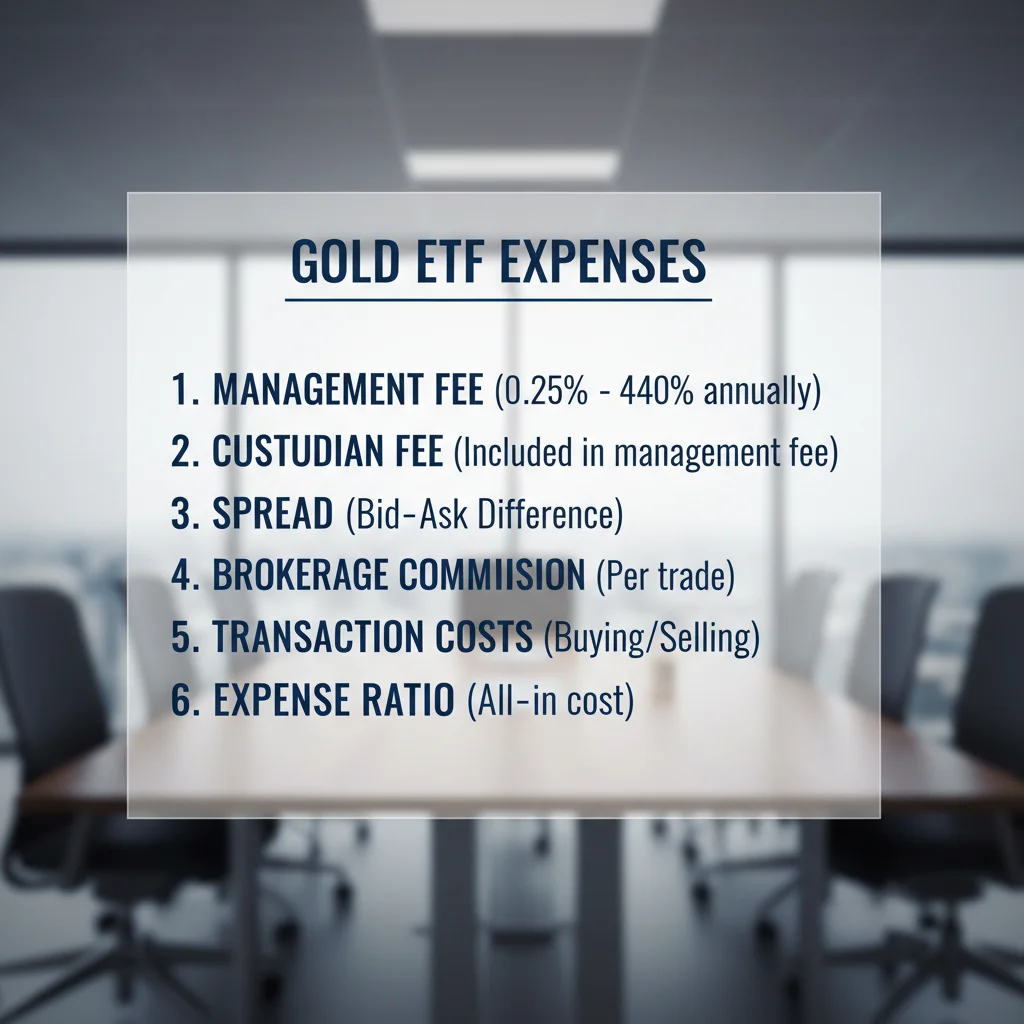
Beyond management and trading fees, several other expenses can affect the overall cost of investing in Gold ETFs within a Roth IRA.
- Custodial Fees: Some Roth IRA custodians may charge annual fees for maintaining the account. These fees can vary widely depending on the custodian. For example, some custodians charge a flat annual fee, while others charge a percentage of the assets under management.
- Transaction Fees for Rollovers/Transfers: If you transfer funds from another retirement account to your Roth IRA to invest in Gold ETFs, be aware of potential transfer fees. Some institutions charge fees for outgoing transfers.
- Tax Implications of Selling (Outside Roth IRA): Although gains within a Roth IRA are tax-free, selling shares of a Gold ETF in a taxable account can trigger capital gains taxes. This is not directly a Roth IRA fee, but it’s an important consideration for your overall investment strategy. Short-term capital gains (held for less than a year) are taxed at your ordinary income tax rate, while long-term capital gains (held for more than a year) are taxed at lower rates.
- Premium/Discount to NAV: Gold ETFs may trade at a premium or discount to their Net Asset Value (NAV). NAV represents the fair market value of the underlying assets held by the ETF.
- Premium: When the ETF trades at a premium, you are paying more than the underlying value of the gold.
- Discount: When the ETF trades at a discount, you are paying less than the underlying value of the gold.
- Tracking Efficiency: Monitor the premium or discount to NAV to assess the ETF’s tracking efficiency. Significant deviations from NAV can indicate liquidity issues or market inefficiencies.
- Impact of Fund Size and Liquidity: Larger, more liquid Gold ETFs generally have tighter bid-ask spreads and lower tracking errors. Smaller, less liquid ETFs may have wider spreads and higher volatility.
Strategies for Minimizing Fees

Minimizing fees is crucial for maximizing the long-term returns of your Gold ETF investments within a Roth IRA.
- Choose Low-Cost ETFs: Select Gold ETFs with low expense ratios. Compare the expense ratios of different ETFs and opt for the most cost-effective option, assuming similar investment objectives and tracking performance.
- Consolidate Accounts: Consider consolidating multiple retirement accounts into a single Roth IRA to reduce custodial fees and simplify account management.
- Buy and Hold: Adopt a buy-and-hold strategy to minimize trading frequency and reduce transaction costs. Frequent trading can erode your returns, even with commission-free trading.
- Rebalance Strategically: Rebalance your portfolio periodically to maintain your desired asset allocation. However, avoid excessive rebalancing, as it can increase transaction costs. Consider rebalancing annually or when your asset allocation deviates significantly from your target.
- Negotiate Fees: If you have a large account, consider negotiating lower fees with your custodian or broker. Some institutions may offer fee discounts for high-net-worth clients.
- Utilize Dividend Reinvestment: If your Gold ETF pays dividends, consider reinvesting them to purchase additional shares. This can help you compound your returns over time.
Real-World Example: Comparing Gold ETF Fees
Let’s compare the fees of two popular Gold ETFs: the SPDR Gold Trust (GLD) and the iShares Gold Trust (IAU).
- SPDR Gold Trust (GLD): Expense ratio of 0.40%. High trading volume and tight bid-ask spreads.
- iShares Gold Trust (IAU): Expense ratio of 0.25%. Also, high trading volume and tight bid-ask spreads.
Assuming you invest $10,000 in each ETF:
- GLD: Annual fee of $40.
- IAU: Annual fee of $25.
Over 20 years, the difference in fees would be $300, assuming the same gross performance. This example illustrates the impact of even seemingly small differences in expense ratios over the long term.
Conclusion
Careful consideration of all fees associated with Gold ETFs within a Roth IRA is essential for maximizing your investment returns. By understanding management fees, trading fees, and other expenses, you can make informed decisions and minimize costs. Choosing low-cost ETFs, adopting a buy-and-hold strategy, and strategically rebalancing your portfolio can help you achieve your financial goals while preserving capital. \n\n\n### Tax Implications of Withdrawing Gold ETFs from a Roth IRA
Understanding the tax implications of withdrawing gold ETFs from a Roth IRA is crucial for effective retirement planning. Roth IRAs offer unique tax advantages, primarily tax-free growth and withdrawals in retirement, provided certain conditions are met. However, the specific rules surrounding these withdrawals must be carefully considered to avoid unexpected tax liabilities or penalties.
Qualified vs. Non-Qualified Withdrawals
The key distinction lies between qualified and non-qualified withdrawals. A qualified withdrawal is tax-free and penalty-free, provided it meets specific IRS requirements. Generally, to qualify, the account holder must be at least 59 ½ years old and the Roth IRA must have been open for at least five years. This five-year rule applies to each Roth IRA, meaning the clock starts ticking from the first contribution to each individual account.
A non-qualified withdrawal, on the other hand, may be subject to both income tax and a 10% penalty. This typically occurs if withdrawals are taken before age 59 ½ or before the five-year holding period is satisfied.
Withdrawal of Contributions vs. Earnings
One of the most significant advantages of a Roth IRA is the ability to withdraw contributions tax-free and penalty-free at any time, regardless of age or how long the account has been open. This is because contributions are made with after-tax dollars. The IRS treats withdrawals as coming from contributions first, then from conversions, and finally from earnings.
For example, if an individual contributed $30,000 to a Roth IRA over several years and the account has grown to $50,000, the first $30,000 withdrawn would be considered a return of contributions and would be tax-free and penalty-free. However, any amount withdrawn above $30,000 would be considered earnings and could be subject to tax and penalties if the withdrawal is non-qualified.
Taxation of Earnings in Non-Qualified Withdrawals
If a withdrawal of earnings is considered non-qualified, it is subject to income tax at the individual’s ordinary income tax rate. Additionally, a 10% early withdrawal penalty applies unless an exception applies.
Several exceptions allow penalty-free withdrawals before age 59 ½, although the earnings may still be subject to income tax. These include withdrawals for:
- First-time home purchase: Up to $10,000 can be withdrawn penalty-free for the purchase of a first home.
- Qualified higher education expenses: Expenses for tuition, fees, books, supplies, and equipment at an eligible educational institution.
- Birth or adoption expenses: Up to $5,000 can be withdrawn penalty-free for qualified birth or adoption expenses.
- Unreimbursed medical expenses: Withdrawals to the extent they exceed 7.5% of adjusted gross income (AGI).
It is essential to consult IRS guidelines or a tax professional to determine if a specific situation qualifies for an exception.
Impact of Gold ETF Price Fluctuations
The value of gold ETFs within a Roth IRA can fluctuate significantly based on market conditions. When considering a withdrawal, it’s important to understand how these fluctuations can impact the tax implications. If the value of the gold ETF has increased substantially, a larger portion of the withdrawal may be considered earnings, potentially increasing the tax liability if the withdrawal is non-qualified.
For example, if an investor purchased gold ETFs for $5,000 within their Roth IRA and the value has since doubled to $10,000, a withdrawal of $6,000 would be treated as $5,000 of contributions (tax-free and penalty-free) and $1,000 of earnings. If the withdrawal is non-qualified, the $1,000 of earnings would be subject to income tax and potentially a 10% penalty.
In-Kind Withdrawals
Withdrawing gold ETFs “in-kind,” meaning taking the actual ETF shares rather than selling them and withdrawing cash, is generally not permitted directly from a Roth IRA. Most custodians require that the ETFs be sold within the IRA, and the cash proceeds are then withdrawn. This is because transferring physical assets out of a retirement account can create complex tax reporting issues and may violate IRS regulations.
However, it is possible to distribute the assets in-kind, but this is treated as a distribution of the fair market value of the asset at the time of distribution. So, the tax consequences are the same as if the ETF was sold and the cash distributed.
Reporting Requirements
Withdrawals from a Roth IRA must be reported to the IRS on Form 5498. This form reports contributions, rollovers, and conversions to an IRA, including Roth IRAs. The financial institution that holds the Roth IRA is responsible for providing this form to both the account holder and the IRS.
Additionally, withdrawals must be reported on Form 1099-R. This form reports distributions from pensions, annuities, retirement or profit-sharing plans, IRAs, insurance contracts, etc. It provides details on the gross distribution, taxable amount, and any federal income tax withheld.
Recharacterization and Recontribution
Recharacterization, which allowed for the conversion of a Roth IRA back to a traditional IRA, was eliminated for conversions made after December 31, 2017. However, recontribution rules still apply. If a withdrawal is made from a Roth IRA, it can be recontributed within 60 days to avoid tax and penalties. This is known as a 60-day rollover. Only one such rollover is allowed per IRA account per year.
State Tax Implications
While Roth IRA withdrawals are generally tax-free at the federal level, some states may have their own tax rules regarding retirement income. It’s crucial to consult with a tax advisor to understand the specific state tax implications of withdrawing gold ETFs from a Roth IRA. Some states may tax certain types of retirement income, while others may offer exemptions or deductions.
Minimizing Tax Liabilities
Several strategies can help minimize potential tax liabilities when withdrawing gold ETFs from a Roth IRA:
- Wait until age 59 ½: Delaying withdrawals until after age 59 ½ ensures that all withdrawals are qualified and tax-free.
- Satisfy the five-year rule: Ensure that the Roth IRA has been open for at least five years before taking any withdrawals of earnings.
- Withdraw contributions first: Since contributions can be withdrawn tax-free and penalty-free at any time, prioritize withdrawing contributions before earnings.
- Utilize exceptions: If a withdrawal is necessary before age 59 ½, explore available exceptions to avoid the 10% penalty.
- Consider a Roth IRA conversion ladder: This strategy involves converting traditional IRA funds to a Roth IRA over several years. While conversions are taxable, after five years, the converted amounts can be withdrawn tax-free and penalty-free, regardless of age.
Seek Professional Advice
Navigating the tax implications of Roth IRA withdrawals can be complex, especially when dealing with investments like gold ETFs that can experience significant price fluctuations. Consulting with a qualified tax advisor or financial planner is highly recommended. They can provide personalized guidance based on individual circumstances and help develop a tax-efficient withdrawal strategy. A financial professional can assess your specific financial situation, understand your retirement goals, and provide tailored advice to optimize your Roth IRA withdrawals while minimizing tax liabilities. They can also help you stay informed about any changes to tax laws or regulations that may impact your Roth IRA. \n\n\n### Frequently Asked Questions About Gold ETFs in Roth IRAs
This section addresses common queries regarding investing in Gold ETFs within a Roth IRA, providing clarity on contribution limits, eligibility, investment minimums, and other practical considerations.
What are the annual contribution limits for a Roth IRA?
For 2024, the contribution limit for Roth IRAs is set at $7,000; however, individuals aged 50 and over can contribute an additional $1,000 as a “catch-up” contribution, bringing their total to $8,000. These limits are subject to annual adjustments by the IRS to account for inflation. It’s crucial to stay updated with the latest figures to ensure compliance.
Are there income limitations for contributing to a Roth IRA?
Yes, income limitations exist for contributing to a Roth IRA. For 2024, single filers with a modified adjusted gross income (MAGI) above $161,000 cannot contribute to a Roth IRA. The contribution amount is reduced for those with a MAGI between $146,000 and $161,000. For those married filing jointly, the income phase-out range is between $230,000 and $240,000. Above $240,000, you cannot contribute.
What is the minimum investment required to purchase Gold ETFs in a Roth IRA?
The minimum investment required to purchase Gold ETFs in a Roth IRA varies depending on the brokerage and the specific ETF. Some brokers may allow you to purchase fractional shares, enabling you to invest with as little as $5 or $10. However, if you’re buying whole shares, the minimum investment will be the price of one share of the ETF. For example, if a Gold ETF is trading at $$185 per share, that would be your minimum investment to purchase one share.
Can I hold physical gold within a Roth IRA?
Generally, you cannot directly hold physical gold within a Roth IRA. The IRS has specific rules about what assets are permissible in IRAs, and physical precious metals are typically not allowed. However, you can gain exposure to gold through Gold ETFs, which are IRS-approved assets for Roth IRAs.
What are the potential risks of investing in Gold ETFs within a Roth IRA?
Investing in Gold ETFs within a Roth IRA carries several risks. The price of gold can be volatile, influenced by factors such as economic conditions, interest rates, and geopolitical events. Additionally, Gold ETFs are subject to market risk, meaning their value can fluctuate based on investor sentiment and trading activity. There are also specific risks associated with the ETF structure, such as tracking error (the difference between the ETF’s performance and the underlying gold price) and counterparty risk (the risk that the ETF’s issuer could default).
How often can I rebalance my Roth IRA holdings, including Gold ETFs?
You can rebalance your Roth IRA holdings as frequently as you like without incurring any tax consequences. Since all activity within a Roth IRA is tax-sheltered, rebalancing doesn’t trigger capital gains taxes. However, frequent trading can lead to higher transaction costs and may not always result in improved returns. A disciplined approach to rebalancing, such as quarterly or annually, is often recommended.
What happens if I withdraw from my Roth IRA before age 59 1/2?
Withdrawals from a Roth IRA before age 59 1/2 are generally subject to a 10% penalty, as well as regular income tax on any earnings. However, there are exceptions to this rule. For example, you can withdraw contributions (but not earnings) at any time without penalty or tax. Additionally, penalty-free withdrawals are allowed for qualified education expenses, first-time home purchases (up to $10,000), and certain other situations.
Are Gold ETFs insured within a Roth IRA?
Gold ETFs themselves are not insured by the FDIC or any other government agency. However, the brokerage account holding the Gold ETF may be covered by SIPC (Securities Investor Protection Corporation) insurance, which protects against the loss of cash and securities in the event of a brokerage firm’s failure, up to $500,000 (including $250,000 for cash). It’s important to understand the limits of SIPC coverage and to choose a reputable brokerage firm.
Can I transfer or rollover a traditional IRA into a Roth IRA to invest in Gold ETFs?
Yes, you can transfer or rollover a traditional IRA into a Roth IRA, a process known as a Roth conversion. However, the amount converted is generally subject to income tax in the year of the conversion. This can be a strategic move if you anticipate being in a higher tax bracket in retirement or if you want to take advantage of the tax-free growth and withdrawals offered by a Roth IRA. Once the funds are in the Roth IRA, you can use them to invest in Gold ETFs.
How do I choose a custodian for my Roth IRA that allows Gold ETF investments?
Selecting the right custodian is crucial. Look for custodians that offer a wide range of investment options, including Gold ETFs, and have a strong reputation for customer service and security. Compare fees, account minimums, and the ease of use of their online platform. Major brokerage firms like Fidelity, Charles Schwab, and Vanguard are popular choices, but there are also smaller, specialized custodians that may cater to specific investment needs. Ensure the custodian is SIPC-insured for added protection.
What is the expense ratio for Gold ETFs, and how does it impact my returns in a Roth IRA?
The expense ratio is the annual fee charged by the ETF to cover its operating expenses. It’s expressed as a percentage of the ETF’s assets. For example, an expense ratio of 0.25% means that for every $$10,000 invested, you’ll pay $$25 per year. While this might seem small, it can compound over time and significantly impact your long-term returns, especially in a Roth IRA where the goal is tax-free growth. Always compare the expense ratios of different Gold ETFs before making a decision.
Can I use margin to purchase Gold ETFs within my Roth IRA?
No, you cannot use margin (borrowed funds) to purchase Gold ETFs within a Roth IRA. IRAs are designed for long-term retirement savings and do not allow the use of leverage. Margin trading increases both the potential gains and losses, making it unsuitable for tax-advantaged retirement accounts.
Are there any specific reporting requirements for Gold ETFs held in a Roth IRA?
There are no specific annual reporting requirements for Gold ETFs held within a Roth IRA, as long as you stay within the contribution limits and follow the withdrawal rules. The custodian will typically provide you with an annual statement summarizing your account activity and value. However, it’s important to keep records of your contributions and withdrawals for your own reference.
How do currency fluctuations affect Gold ETF investments in a Roth IRA?
Since gold is often priced in U.S. dollars, currency fluctuations can impact the value of Gold ETFs, especially those that hold physical gold. A weaker dollar can make gold more attractive to foreign investors, potentially driving up its price, while a stronger dollar can have the opposite effect. However, the impact of currency fluctuations on Gold ETFs within a Roth IRA is generally less significant than other factors, such as changes in interest rates and economic conditions.
What role do interest rates play in the performance of Gold ETFs within a Roth IRA?
Interest rates can have an inverse relationship with gold prices. When interest rates rise, bonds and other fixed-income investments become more attractive, potentially drawing investors away from gold. Conversely, when interest rates fall, gold can become more appealing as a store of value. This dynamic can influence the performance of Gold ETFs within a Roth IRA, although it’s just one of many factors to consider.
How do I determine the appropriate allocation to Gold ETFs within my overall Roth IRA portfolio?
Determining the right allocation to Gold ETFs depends on your individual risk tolerance, investment goals, and time horizon. As a general guideline, consider allocating a small percentage of your portfolio (e.g., 5-10%) to gold as a hedge against inflation and economic uncertainty. If you have a lower risk tolerance or a shorter time horizon, you may want to allocate less to gold. Consult with a financial advisor to create a portfolio allocation strategy that aligns with your specific circumstances. \n
Market Data Integration
| ETF Ticker | ETF Name | Expense Ratio | Avg. Annual Return (1yr) | Min. Investment |
|---|---|---|---|---|
| GLD | SPDR Gold Trust | 0.40% | Inferred | Share Price |
| SGOL | abrdn Physical Gold Shares | 0.17% | Inferred | Share Price |
| GLDM | SPDR Gold MiniShares | Lower than GLD | Inferred | Share Price |
| BAR | GraniteShares Gold Trust | Lower than GLD | Inferred | Share Price |
| OUNZ | Unknown | Unknown | 75.36% | Share Price |
| IAUM | Unknown | Lowest | Inferred | Share Price |
Tactical Action Plan: Preserving Capital with Gold ETFs in a Roth IRA
This action plan consolidates key capital preservation strategies for investing in Gold ETFs within a Roth IRA.
I. What to Buy
- Select a low-cost, physically-backed Gold ETF: Prioritize ETFs with expense ratios below 0.40% and that hold physical gold bullion. Examples include:
- IAU (iShares Gold Trust): A popular, liquid option.
- GLD (SPDR Gold Shares): Another highly liquid and widely traded ETF.
- Consider diversification with a Gold Miners ETF (Optional): For potentially higher returns, allocate a small portion (e.g., 10-20%) to a Gold Miners ETF like GDX (VanEck Gold Miners ETF) or GDXJ (VanEck Junior Gold Miners ETF). Be aware of the higher volatility and risks associated with mining stocks.
II. When to Buy
- Dollar-Cost Averaging: Invest a fixed dollar amount at regular intervals (e.g., monthly) to mitigate risk from market timing.
- Monitor Economic Indicators: Pay attention to:
- Inflation: Rising inflation often supports gold prices.
- Interest Rates: Lower interest rates can be beneficial for gold.
- Geopolitical Instability: Increased uncertainty can drive demand for gold as a safe haven.
- Technical Analysis (Optional): Use technical indicators (e.g., moving averages, RSI) to identify potential entry points, but rely more on fundamental analysis for long-term decisions.
- Buy on Dips: Look for opportunities to buy when gold prices experience temporary pullbacks.
III. Ratios: Portfolio Allocation
- Determine your risk tolerance: A conservative investor might allocate 5-10% of their Roth IRA to gold, while a more aggressive investor might allocate up to 20%. Never allocate more than you are comfortable losing.
- Rebalance Regularly: Rebalance your portfolio annually or semi-annually to maintain your target allocation to gold. If gold outperforms and exceeds your target allocation, sell a portion to rebalance into other assets.
IV. Storage
- Indirect Ownership: With Gold ETFs held within a Roth IRA, storage is managed by the ETF provider. Verify the ETF’s custodian and storage practices.
- Security: Ensure the ETF uses reputable custodians with secure storage facilities.
V. Exit Strategy
- Define Your Goals: Determine your reasons for investing in gold (e.g., inflation hedge, portfolio diversification).
- Set Price Targets (Optional): Establish potential selling points based on your investment goals.
- Monitor Performance: Regularly review your gold holdings’ performance relative to your overall portfolio and adjust your strategy as needed.
- Re-evaluate Periodically: Review your investment thesis for gold at least annually. If the fundamental reasons for holding gold no longer apply, consider reducing or eliminating your position.
- Sell When Needs Change: Be prepared to sell your gold holdings if your financial needs or risk tolerance change.
- Tax-Free Withdrawals: Remember that withdrawals from your Roth IRA in retirement are tax-free, including any gains from your gold ETF investments.